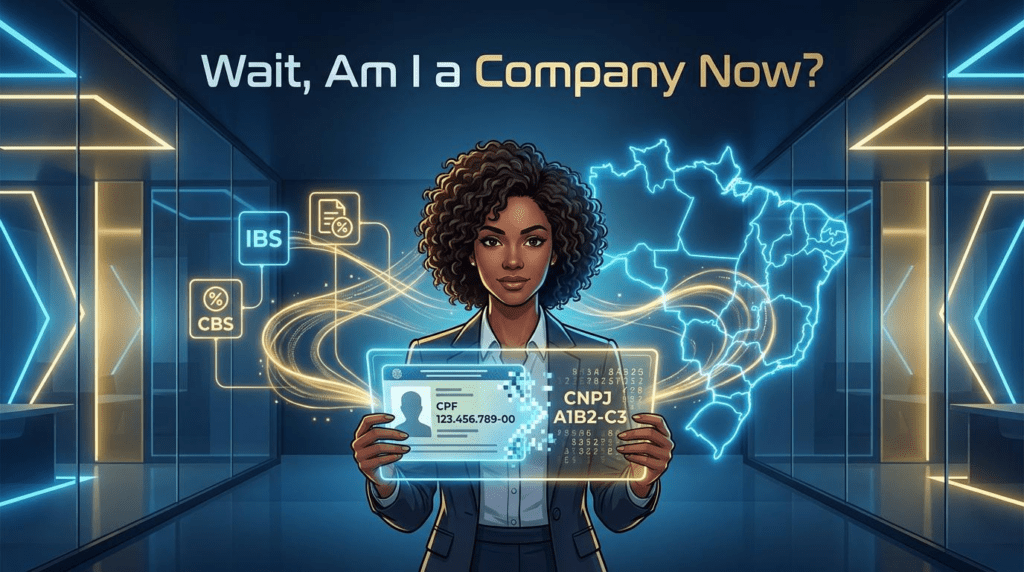
1. The "Wait, What?" Moment: The Ontology of the Technical CNPJ
There is a peculiar dissonance in the life of a Brazilian freelancer. One day you are a doctor, a graphic designer, or an independent driver, operating under the familiar, singular identity of your CPF. The next, the state informs you that you require a CNPJ. It feels like a forced metamorphosis—a push into the cold, bureaucratic world of "the company." But before the existential dread of corporate taxes and complex payrolls sets in, we must look closer at what is actually happening.
We are witnessing the birth of the "Technical CNPJ." In the philosophical landscape of the new tax reform, this isn't a transformation of who you are, but rather a digital name tag for a new era of transparency. You remain, for all intents and purposes, a Pessoa Física. Your Income Tax (IRPF) and your relationship with the INSS are still tethered to your persona as an individual. However, for the sake of the new VAT system—the IBS and CBS—your invoices will now bear this new numeric (and soon, alphanumeric) seal. It is a tool for the taxman to track credits, ensuring that the gears of the new Dual VAT system turn without friction.
2. How Did We Get Here? Escaping the Tax "Manicomio"
To understand this shift, one must appreciate the sheer complexity of what Brazilians affectionately call the "tax manicomio" (tax asylum). For decades, the system was a labyrinth of municipal, state, and federal levies that rarely spoke the same language. Individuals often operated on the fringes of this system using "avulsa" (one-off) municipal invoices tied to their CPFs.
The turning point was Constitutional Amendment 132 in 2023, a massive structural overhaul designed to drag Brazil’s consumption taxes into the 21st century. The Dual VAT system—comprising the IBS and CBS—requires a national infrastructure of real-time traceability. The old CPF-based municipal systems were simply not built for this level of interconnectedness. By the time Complementary Law No. 214 was passed in early 2025, the "idea" of a technical registry had become a concrete mandate for anyone earning significant income through services, rentals (over R$ 240,000 annually), or rural production (over R$ 3.6 million). We are upgrading the national ledger, and the CNPJ is the only font it knows how to read.
3. The Watercooler Talk: Progress or Panopticon?
As with any systemic shift, the narrative depends entirely on who you ask. The optimists within the government frame this as a triumph of administrative simplicity. "One ID for everything!" they claim, promising a future where the friction of doing business vanishes into a cloud of unified data.
However, if you step into the offices of accountants and lawyers, the tone shifts toward the cautionary. They see the Technical CNPJ as a form of "revenue monitoring in real-time." It is as if the taxman has decided to move into your home office, observing every transaction the moment it occurs. There is also a brewing market anxiety. Analysts worry that large corporations, seeking the path of least resistance, might stop hiring individuals altogether. If claiming tax credits is "easier" when dealing with a full-fledged legal entity, the autonomous worker with their technical ID might find themselves at a competitive disadvantage.
4. The Drama: Alphanumeric Anarchy and Identity Crises
The implementation of this rule is not without its "glitches in the matrix." We are quite literally running out of numbers. Because of the millions of new registries required, the government is introducing alphanumeric CNPJs starting in July 2026. This might sound like a minor detail, but for a country running on legacy billing software and aging ERP systems, it is a potential digital heart attack. Is your software ready for a CNPJ that includes letters, or will the system simply refuse to acknowledge your existence?
Beyond the technical, there is the legal and psychological. The OAB (Brazilian Bar Association) has expressed concern over the "loose ends" in the legislation—vague penalties and missing regulations that leave the individual vulnerable. Freelancers are caught in an identity crisis, fearing that this technical registry is merely the first step toward being pushed into higher tax brackets or being forced to pay exorbitant accounting fees before their business is truly ready to scale.
5. Mark Your Calendars: The Road Ahead
The transition is not a sudden cliff, but a series of deliberate steps. We must watch the calendar closely:
- January 2026 - The "Practice Run": A test period for the IBS/CBS. Think of it as a dress rehearsal where you can practice invoicing without the actual tax bite.
- July 2026 - The Big Reveal: This is the deadline. Mandatory registration goes live, and the alphanumeric codes begin to circulate.
- August 2026: The official rollout of the National Electronic Service Invoice (NFS-e) for all autonomous workers.
- The "Nano" Hope: For those on the smaller end of the spectrum, there is the "Nanoempreendedor" debate. If your annual revenue stays under R$ 40,500, you might find a simpler path through the bureaucracy—a "get out of jail free" card that allows you to remain small without being crushed by the weight of the new system.
As we move toward 2026, the question "Am I a company now?" remains legally answered as "No," but operationally, the answer is increasingly "Sort of." We are entering an era of the hybrid professional, where the person and the registry become increasingly intertwined in the eyes of the state.
Aproveite as Melhores Ofertas do Prime Day
Descontos exclusivos em notebooks, celulares, livros, eletrônicos, escritório, casa inteligente, Alexa, Kindle, SSD, monitores, impressoras e muito mais.
⚡ Ofertas por tempo limitado. Os estoques podem acabar rapidamente.
🛒 Acessar Ofertas do Prime DayTransparência: O SpedTax participa do Programa de Associados da Amazon e pode receber comissão por compras qualificadas realizadas por meio deste link, sem custo adicional para você.